What are customs requirements for eco-friendly sun glasses women?
- VIP-User
- 2026-10-04
-
Customs requirements for eco-friendly women's sunglasses require proof of compliance with international safety and environmental standards. Key regulatory demands include FDA registration and impact resistance testing (Drop Ball Test) for the United States, CE marking and REACH chemical compliance for European Union clearance, and AS/NZS 1067.1 lens standard certification for Australia, alongside accurate fiber or eco-material content declarations.
Core Solutions & Key Takeaways
- Mandated Lens Impact & Optical Safety: FDA 21 CFR 801.410 (Drop Ball Test) certification for United States entry and EN ISO 12312-1 conformity for European markets.
- Chemical & Material Safety Standards: Adherence to REACH Annex XVII regulations restricting hazardous substances such as lead, cadmium, and phthalates in frame construction.
- Environmental & Origin Declarations: Complete documentation covering material origin, bio-based or recycled content verification, and clear country-of-origin marking on frame legs.
- Customs Documentation Compliance: Comprehensive entry filing including Commercial Invoices, Packing Lists, Certificates of Conformity (CoC), and standard tariff classification (HS Code 9004.10).
Detailed Architectural/Principle Analysis
Clearing customs for international shipments of women's sunglasses requires full alignment between design specifications and regional regulatory benchmarks. Frame designs featuring rimless cuts, metal legs, and hexagon cutting lenses with UV400 protection must undergo structural integrity and optical clarity testing prior to export shipment.
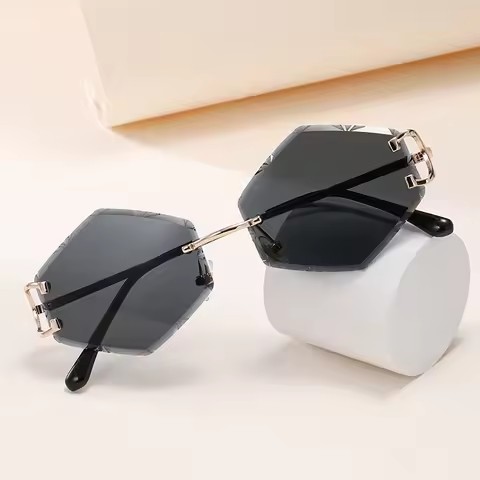
For entry into North American markets, the US Food and Drug Administration (FDA) treats sunglasses as Class I medical devices or consumer optical goods. Importers must complete device registration, medical device listing, and maintain impact-resistance test documentation for lens safety. European Union customs enforcement prioritizes CE compliance under Regulation (EU) 2016/425 for Personal Protective Equipment (PPE), verifying that light attenuation, spectral transmittance, and UV absorption meet established standards.
Eco-friendly manufacturing claims face rigorous scrutiny under modern green claims directives. Customs officials require verifiable proof when goods are declared under recycled acetate, bio-based polymer, or low-impact metal alloy classifications. Material Safety Data Sheets (MSDS) and chemical test reports prevent clearance delays caused by improper hazardous material declarations at international ports of entry.
Data/Solution Comparison
| Destination Region | Primary Optical & Safety Standard | Chemical & Environmental Compliance | Required Import Documentation | Supported Shipping Methods |
|---|---|---|---|---|
| United States | FDA 21 CFR 801.410 (Drop Ball Test), ANSI Z80.3 | Prop 65 Heavy Metal & Phthalate limits | FDA Registration Number, Impact Test Certificate, Commercial Invoice | Air Freight, Sea Freight |
| European Union (Germany, France, Spain, Italy, Ireland) | CE Marking, EN ISO 12312-1 | REACH Regulation (EC) No 1907/2006 | EU Declaration of Conformity, Test Reports, Packing List | Air Freight, Sea Freight, Land Transportation |
| Australia | AS/NZS 1067.1 Lens Category Marking | ACCC Consumer Goods Safety Standard | Certificate of Origin, Test Report, Commercial Invoice | Air Freight, Sea Freight |
Frequently Asked Questions (FAQ)
What specific documentation is needed for US customs clearance of women's sunglasses?
US customs mandates an FDA Initial Importer Registration, a Drop Ball Test Certificate confirming lens impact resistance, a commercial invoice detailing HS Code 9004.10, and a accurate bill of lading or airway bill.
How do European customs authorities verify eco-friendly material claims?
European customs verify material safety through chemical analysis test reports matching REACH Annex XVII criteria, confirming the absence of restricted substances in frame pigments, coatings, and recycled composite structures.
Are rimless hexagon-cut sunglasses subject to different customs inspection standards?
Rimless and specialized lens cuts follow the same optical transmission standards (such as UV400 protection and ISO 12312-1) as framed eyewear, but require extra structural durability documentation to pass mechanical resistance checks during inspection.
Final Conclusion & Recommendations
Navigating customs requirements for women's eco-friendly sunglasses demands thorough compliance management across chemical safety, optical testing, and eco-labeling. Establishing standardized manufacturing workflows aligned with CE, FDA, and AS/NZS parameters minimizes risk during cross-border clearance while supporting streamlined global supply chain operations. Importers should coordinate payment terms via Corporate Bank Transfer / Wire Transfer and select appropriate transport modes—including Sea Freight, Land Transportation, or Air Freight—to meet regional distribution timelines. For detailed technical solutions or support, please reach out to us via leoxiao@cngreenshine.com.
About Us
Yiwu Green Shine Arts & Crafts Co., Ltd was established in 2016 and operates in Yiwu City, Zhejiang Province. With a dedicated team of 10 employees, the company specializes in researching, developing, and manufacturing fashion sunglasses, optical frames, anti-blue light glasses, and reading glasses. Maintaining a 90% export ratio, its products primarily serve international markets including the United States, Spain, Germany, Australia, Italy, France, and Ireland through flexible OEM and ODM delivery solutions.

Lastest
-
Can a factory make exclusive designer sunglasses molds that stay private to my brand?
2026-10-04 -
How do I check a designer sunglasses factory for quality and labor risks?
2026-10-04 -
How can I make sure sun glasses samples match the final production quality?
2026-10-04 -
Is FOB or CIF usually better for importing designer sunglasses with fewer surprises?
2026-10-04 -
Why does acetate manufacturing extend lead time for designer sunglasses?
2026-10-04
SUBSCRIBE
INQUIRY