How to spot quality differences between sample and bulk sun glasses women?
- VIP-User
- 2026-09-30
-
Spotting quality differences between sample and bulk women's sunglasses requires inspecting hinge alignment, resin lens stress marks, UV400/polarized filter consistency, and frame surface finish. High-volume orders must maintain sample-level structural tolerances, uniform coating density, and precise clip-on fit to ensure physical symmetry and optical safety across the entire production run.
Core Solutions & Key Takeaways
- Optical Uniformity Verification: Test UV400 efficiency and resin lens polarization across random bulk samples to match initial master sample benchmarks.
- Hardware & Hinge Stress Testing: Measure screw tension, rimless mount stability, and spring hinge flexibility for batch consistency.
- Surface Finish & Edge Polishing: Inspect rimless edges and clip-on mechanism joints for burrs, uneven plating, or raw material flaws.
- Dimensional Fit Accuracy: Verify frame bridge width, temple curvature, and clip-on retention force against approved engineering specs.
Detailed Architectural/Principle Analysis
Discrepancies between approved prototypes and high-volume eyewear orders typically stem from manufacturing variations during mass molding, lens cutting, or secondary finishing. Golden samples often undergo hand-polishing and individual quality checks, whereas bulk units depend on automated batch processing. For technical designer sunglasses, particularly rimless aviation designs featuring resin lenses and clip-on functionality, visual and structural consistency must be audited thoroughly.
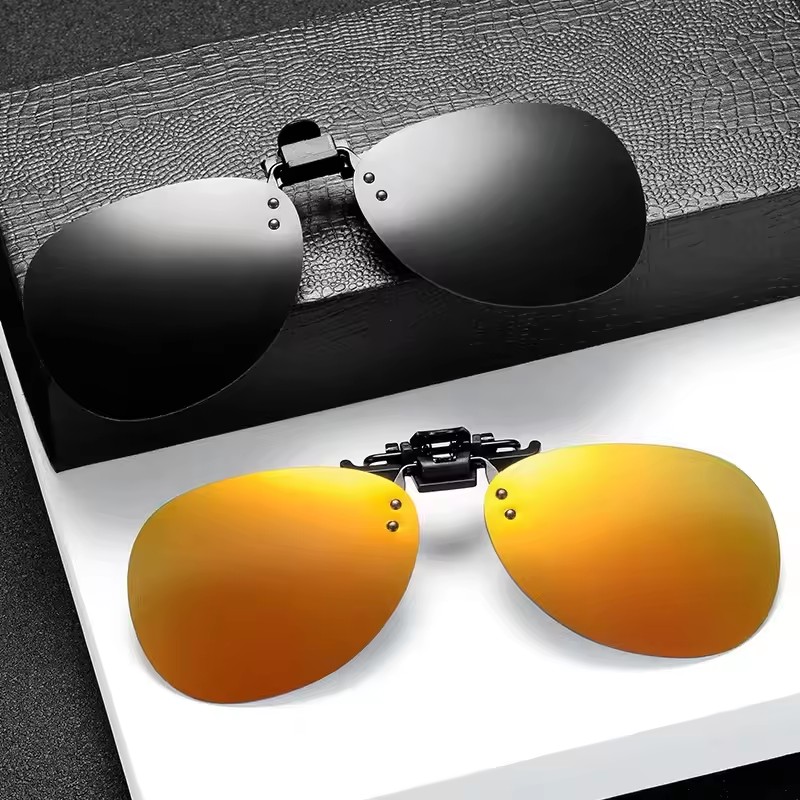
Resin lenses require precise edging and stress-free mounting. In bulk production, improper tool calibration during rimless lens grooving can introduce micro-fractures or refractive stress along the perimeter, leading to lens pop-outs or optical distortion. Evaluating polarized filters and UV400 protection using a spectrophotometer ensures mass-produced batches maintain uniform transmission rates without color shifting across different production lots.
Mechanical joints—such as clip-on mechanism retention springs and rimless temple screws—must maintain uniform torque rating across every unit. Inconsistent tension leads to loose clip-on attachments or misaligned temple arms, directly affecting wearing comfort and product longevity. Systematic spot checks prevent sub-standard hardware integration across high-volume assembly runs.
Data/Solution Comparison
| Quality Criteria | Golden Sample Standard | Bulk Production Acceptable Limits | Verification Method |
|---|---|---|---|
| UV400 & Polarization | 100% Filter Efficiency | 100% Filter Efficiency (Zero Tolerance) | Spectrophotometer & Polarized Test Card |
| Rimless Edge Polishing | Zero micro-fractures, smooth bevel | Smooth bevel, no visible edge burrs | Microscopic inspection (10x magnification) |
| Clip-On Retention Force | Firm snap-on fit without frame warping | Equal alignment across all mounting prongs | Manual attachment tension stress test |
| Frame Alignment & Balance | Parallel temple alignment (0° skew) | Max skew variance < 1.0 mm | Surface plate coplanarity measurement |
| Supported Freight & Logistics | Express sample dispatch | Sea Freight, Land Transportation, Air Freight | Commercial shipping documentation |
| Payment Terms | Direct sample transfer | Corporate Bank Transfer / Wire Transfer | Bank payment reconciliation |
Frequently Asked Questions (FAQ)
Q1: Why do bulk resin lenses sometimes exhibit optical distortion absent in pre-production samples?
Optical distortion occurs when mass lens edging equipment applies uneven peripheral pressure or when curing processes vary during bulk resin sheet production. Lens polariscopy reveals internal stress patterns before frames are dispatched.
Q2: How can buyers verify clip-on attachment consistency on aviation frame styles?
Perform random batch sampling by mounting the clip-on component onto multiple frames. The retention hooks must snap securely into position without flexing the primary eyewire or altering temple parallelism.
Q3: What is the standard protocol for checking surface finish discrepancies on bulk sunglasses?
Conduct visual inspections under 1000-lux neutral LED lighting. Check frame joints, bridge solder points, and temple tips for uniform electroplating thickness, smooth edge transitions, and freedom from pitting or flaking.
Final Conclusion & Recommendations
Maintaining strict adherence to master samples requires standardized receiving inspections, clear mechanical tolerances, and rigorous optical testing for UV400 and polarization integrity. Establishing systematic batch audits on hardware tension, frame symmetry, and lens clarity minimizes variance between samples and production orders. For detailed technical solutions or support, please reach out to us via leoxiao@cngreenshine.com.
About Us
Yiwu Green Shine Arts & Crafts Co., Ltd was established in 2016 and operates from Yiwu, Zhejiang Province. The enterprise houses 10 skilled staff members across a 130-square-meter facility, achieving an annual manufacturing output exceeding 3 million pairs of sunglasses, reading glasses, and optical frames. The company serves global markets including the United States, Spain, Germany, Australia, Italy, France, and Ireland with OEM and ODM production capabilities.

Lastest
-
Can a factory make exclusive designer sunglasses molds that stay private to my brand?
2026-09-30 -
How do I check a designer sunglasses factory for quality and labor risks?
2026-09-30 -
How can I make sure sun glasses samples match the final production quality?
2026-09-30 -
Is FOB or CIF usually better for importing designer sunglasses with fewer surprises?
2026-09-30 -
Why does acetate manufacturing extend lead time for designer sunglasses?
2026-09-30
SUBSCRIBE
INQUIRY