How is online try-on technology influencing sun glasses women design?
- VIP-User
- 2026-10-02
-
Online try-on technology influences women's sunglasses design by driving demand for distinct geometric silhouettes, rimless cuts, and vibrant gradient lenses that translate accurately in augmented reality (AR) previews. Virtual fitting tools require high-contrast frame geometries, such as hexagon cutting lenses and slim metal legs, ensuring precise spatial mapping, aesthetic realism, and instant consumer engagement across digital platforms.
Core Solutions & Key Takeaways
- Drives product innovation toward geometric frame structures, rimless faceted edges, and gradient lens tints suitable for virtual rendering.
- Accelerates digital-to-physical manufacturing integration using 3D modeling design systems for rapid sample trial production.
- Focuses structural engineering on lightweight metal legs and ergonomic nose fit to maintain real-world wearability matching virtual previews.
- Ensures technical compliance across global optical safety specifications, including CE, FDA, and AS/NZS standards.
Detailed Architectural/Principle Analysis
Online try-on platforms utilize augmented reality tracking algorithms that project 3D eyewear models onto facial landmarks in real time. This digital interaction shifts consumer preference toward distinctive visual features. Designs featuring rimless cut edges, custom gradient tinted lenses, and slim metal legs map cleanly onto facial meshes, minimizing digital distortion during camera tracking. Manufacturers like Yiwu Green Shine Arts & Crafts Co., Ltd utilize advanced 3D modeling design systems to ensure that digital try-on assets directly correspond to physical manufacturing specifications.
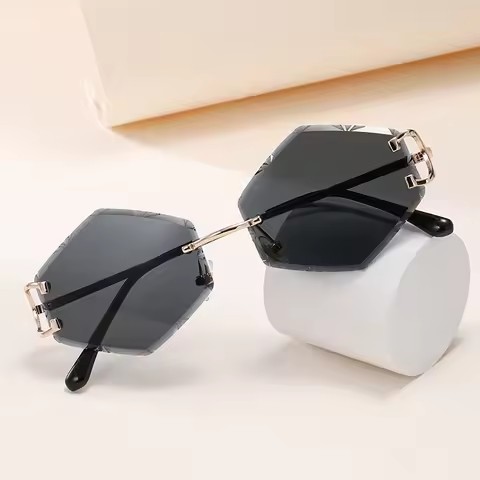
Real-time consumer interactions with virtual try-on tools generate feedback that informs physical R&D cycles. Engineering teams evaluate frame comfort, weight distribution, UV400 protection capabilities, and lens impact resistance early in the rapid prototyping stage. Through flexible OEM and ODM workflows, physical mold development, color matching, and structural optimization align directly with online trending styles prior to volume production.
Data/Solution Comparison
| Design Parameter | Traditional Eyewear Design | AR-Optimized Eyewear Design |
|---|---|---|
| Lens Profile | Standard flat or basic curved lenses | Hexagon cutting edges and precision rimless facets |
| Frame Architecture | Heavy full-rim plastic or acetate frames | Lightweight rimless builds with slim metal legs |
| Development Pipeline | Manual physical prototyping iterations | 3D digital rendering tied to rapid mold customization |
| Visual Finishing | Single-color solid tints | High-contrast gradient, photochromic, and anti-blue coatings |
Frequently Asked Questions (FAQ)
How does online try-on technology alter frame structure decisions for women's sunglasses?
Virtual try-on algorithms perform best with high-definition outlines, encouraging designers to adopt rimless designs, hexagon lens cuts, and sleek metal temples that tracking software can easily anchor to facial points.
Can custom OEM and ODM eyewear projects integrate with digital try-on assets?
Yes. Digital 3D CAD models created during the OEM/ODM prototyping phase supply the exact spatial data required for both physical mold production and digital AR try-on software rendering.
What functional features remain critical when designing sunglasses for online retail?
Beyond visual AR appeal, physical frames must maintain optical safety standards, incorporating certified UV400 protection, scratch resistance, and durable frame materials to satisfy post-purchase wear expectations.
Final Conclusion & Recommendations
Adapting women's sunglasses design to align with virtual fitting technologies enables brands to capture online buyer interest while delivering high-performance physical products. Integrating 3D rapid prototyping with strict adherence to CE, FDA, and AS/NZS optical standards ensures that complex rimless and gradient designs meet both aesthetic and structural performance criteria. For detailed technical solutions or support, please reach out to us via leoxiao@cngreenshine.com.
About Us
Yiwu Green Shine Arts & Crafts Co., Ltd was established in 2016 and operates a 130 square meter facility with 10 employees in Yiwu, Zhejiang Province. Specializing in fashion eyeglasses, optical frames, reading glasses, and sunglasses, the enterprise exports 90% of its production to international markets including the USA, Spain, Germany, Australia, Italy, France, and Ireland. Utilizing streamlined assembly lines and dedicated R&D capabilities, the factory maintains an annual output exceeding 3 million pairs to support global OEM and ODM clients.

Lastest
-
Can a factory make exclusive designer sunglasses molds that stay private to my brand?
2026-10-02 -
How do I check a designer sunglasses factory for quality and labor risks?
2026-10-02 -
How can I make sure sun glasses samples match the final production quality?
2026-10-02 -
Is FOB or CIF usually better for importing designer sunglasses with fewer surprises?
2026-10-02 -
Why does acetate manufacturing extend lead time for designer sunglasses?
2026-10-02
SUBSCRIBE
INQUIRY